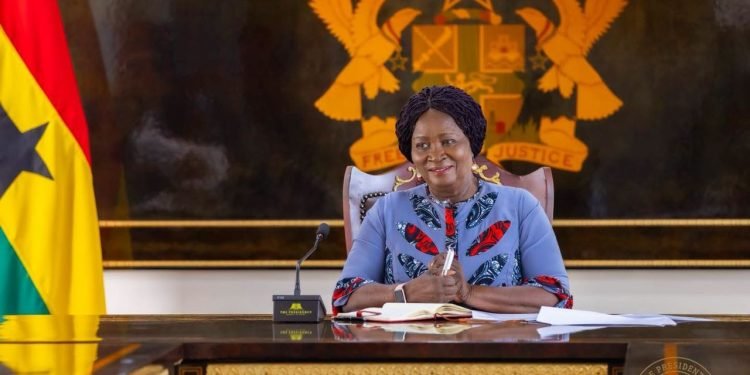
Vice President Professor Naana Jane Opoku-Agyemang has called for the accelerated development of the Volta Lake into a logistics and commercial transport corridor to support trade, agriculture and job creation.
According to her, properly developing the lake could transform Ghana’s transport network by creating a multimodal route connecting the southern and northern parts of the country, while also opening up opportunities for communities along the corridor.
Speaking at the World Bank Western and Central Africa Senior Leadership Team Retreat in Accra on September 3, 2026, the Vice President said the Volta Lake presents a major opportunity to reshape Ghana’s economic geography.
She proposed a multimodal transport system in which goods would move from Tema to Akosombo by road or rail, before being transferred to commercially operated barges for onward transportation through the lake.
The goods could then be transferred at inland terminals to road networks connecting Tamale and markets in Burkina Faso, Mali and the wider Sahel.
“If properly developed, it can connect northern Ghana more efficiently to the south, support agriculture, facilitate trade, create industrial activity, and open opportunities for communities,” Prof. Opoku-Agyemang said.
She described the proposed development as more than a transport project, arguing that the Volta Lake could become a major “jobs corridor” as infrastructure investment stimulates industrial and commercial activity.
The Vice President said the government is open to working with the International Finance Corporation (IFC) to structure the Volta Lake Transport Project in a way that is commercially viable, attractive to private investors and integrated into Ghana’s broader economic strategy.
She outlined potential roles for the World Bank Group, with the World Bank supporting public infrastructure, institutional capacity and the policy framework, while IFC could help structure transactions and mobilise private capital.
The Multilateral Investment Guarantee Agency (MIGA), she added, could help mitigate qualifying investment risks.
Prof. Opoku-Agyemang stressed that the approach reflects a broader shift in Ghana’s development strategy towards using public resources to mobilise greater private investment.
She said the country must move beyond financing isolated projects and instead build economic ecosystems capable of generating enterprises and productive employment at scale.
The Vice President linked the proposed Volta Lake corridor to the government’s wider economic transformation agenda, including the 24-Hour Economy, Big Push infrastructure programme, agricultural transformation and accelerated export initiatives.
She said these interventions must be connected more deliberately to create productive opportunities, linking infrastructure to production, finance to investment, skills to enterprise and Ghanaian businesses to larger markets.
The Vice President also emphasised the importance of regional trade, particularly through the African Continental Free Trade Area (AfCFTA), saying Ghana’s success should ultimately be measured by the ability of local businesses to use the continental market to expand.
She said developing efficient logistics infrastructure would be critical to enabling Ghanaian manufacturers, farmers, service providers and technology firms to participate competitively in regional value chains.
Prof. Opoku-Agyemang said the ultimate objective must be to create productive jobs at a scale that matches the aspirations of Ghana’s growing population.
“The task now is to bring these efforts together around a coherent jobs strategy; linking skills to enterprise, infrastructure to production, finance to investment, and our firms to larger markets,” she said.
The Vice President expressed Ghana’s readiness to work with the World Bank Group, IFC, MIGA, the private sector and development partners to advance the country’s economic transformation agenda.