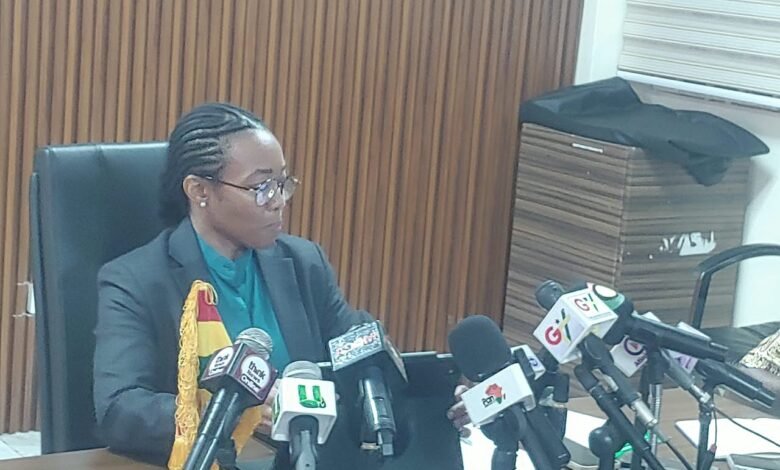
The government is taking steps to transform the Ghana Space Science and Technology Institute (GSSTI) into a fully-fledged *Ghana Space Agency* to position the country to benefit from the growing global space economy.
The Minister for Environment, Science and Technology, *Dr. Zanetor Agyeman-Rawlings*, disclosed this at a media engagement held as part of her first 100 days in office on October 2nd, where she outlined government’s plans to make space science and technology a more integral part of Ghana’s national development agenda.
According to the Minister, the process towards establishing the Agency has begun following Cabinet approval, with work expected to advance on the necessary legislation and institutional framework.
*Mandate of the New Agency*
Dr. Agyeman-Rawlings said the proposed Agency will:
– Coordinate Ghana’s space activities
– Facilitate research and innovation
– Promote public-private partnerships
– Support the development of space infrastructure
– Strengthen international cooperation
> “The objective is not simply to create another institution. The objective is to establish a capable national institution that can coordinate Ghana’s activities and enable the country to participate meaningfully in the global space economy,” she said.
*Focus on Practical Solutions*
The Minister stressed that Ghana’s space programme will focus on practical applications, not prestige. Key areas include agriculture, flood forecasting, climate adaptation, environmental monitoring, telecommunications, maritime surveillance, urban planning and national security.
She noted that Ghana’s location near the equator, along the Gulf of Guinea, and its stability in West Africa positions it as a hub for Earth observation, satellite data and research.
“The value of a satellite image is not simply the image itself. Its real value lies in what we can do with the information,” she added.
The technology will be deployed to combat illegal mining (galamsey), deforestation, land degradation and pollution of water bodies, using satellite imagery, drones, geospatial systems and AI.
Dr. Agyeman-Rawlings said Ghana’s greatest space asset is its people. Government will promote collaboration between universities, research institutions, industry and international partners, and encourage young Ghanaians to pursue careers in aerospace engineering, astrophysics, remote sensing, AI, robotics, data science, space law and space entrepreneurship through scholarships and exchange programmes.
She also called for greater private sector participation, with commercial opportunities in agriculture, insurance, banking, telecommunications, logistics, mining and disaster management.
Government will provide the policy and regulatory framework, academia will generate knowledge, and private companies will commercialise innovation
As part of her 100-day agenda, the Minister outlined:
1. Strengthening stakeholder engagement on Ghana’s Space Policy
2. Advancing the legislative framework for the Ghana Space Agency
3. Identifying priority infrastructure and capacity needs
4. Deepening partnerships with international space agencies and development partners
She stressed that Ghana does not need to develop every component independently and will leverage international cooperation, referencing recent engagements in Germany, including the ministerial meeting in Munich and a visit to the European Southern Observatory.
Dr. Agyeman-Rawlings linked the agenda to the African Union’s Agenda 2063 and called on the media to support the vision.
“The space economy of the 21st century is increasingly about solving real problems, creating economic opportunities, and improving lives.”