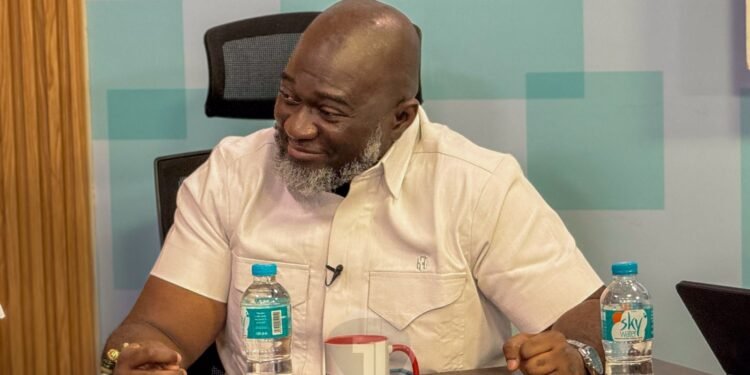
The Executive Secretary of the Chamber of Petroleum Consumers (COPEC), Duncan Amoah, has rejected claims that investigations into politicians and public officials amount to an attack on Ghana’s democracy.
According to him, the ongoing investigations involving some former government officials should not automatically be interpreted as political persecution, arguing that accountability is an essential component of democratic governance.
His comments follow the New Patriotic Party’s (NPP) “Democracy Under Attack” demonstration on August 6, 2026, during which the party raised concerns over what it described as threats to democratic governance and the alleged targeting of its members.
Speaking on the Big Issue on Saturday, August 8, Mr Amoah said he does not believe Ghana’s democracy is currently under attack.
He explained that democracy requires institutions to function independently, while allowing citizens to criticise how those institutions operate.
“When you have institutions get to work, you don’t have any objection but to sometimes critique the way institutions work. But to lump everything together and say the entire democratic process is under attack, some of us would beg to differ,” he said.
Mr Amoah noted that, unlike in some countries where opposition figures are targeted simply because of their political affiliation, he has not seen a similar situation in Ghana.
“I have not in Ghana seen or come across an opposition element being just vocal and being targeted by government,” he said.
He further argued that Ghana continues to enjoy considerable freedom of expression, another key pillar of democracy.
“Freedom of speech, which is one of the core tenets of democracy, clearly is also not being attacked as we speak. You can speak your mind,” Mr Amoah said.
However, he cautioned that freedom of expression should not be used as a justification for threats or intimidation.
According to him, political actors must distinguish between legitimate criticism of government policies and statements that threaten individuals.
“Speaking your mind does not mean infringing on the freedoms or liberties of other people,” he said.
Mr Amoah expressed concern about what he described as the growing use of subtle threats in Ghana’s political discourse, particularly statements suggesting that political opponents will be dealt with when power changes hands.
“You see a threat from the opposition that says the tables will turn and will do things to you. You would hear functionaries sometimes issue those threats,” he said.
He argued that such rhetoric could create a political culture in which public officials expect protection from accountability because of their party affiliation.
“What you are indirectly saying is that, okay, even if we did wrong, or even if adverse findings are made against us, do not go after us, because someday you may not be in power,” he said.
Mr Amoah warned that such an approach would ultimately hurt the Ghanaian public rather than either of the country’s major political parties.
“If we allow this country to be governed that way, it is not the NPP-NDC that suffers, it is the people,” he said.