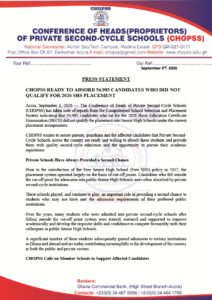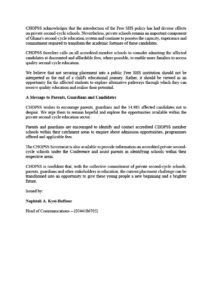
The Conference of Heads of Private Second-Cycle Schools (CHOPSS) has assured the 54,985 candidates who were not placed into Senior High Schools (SHSs) under the 2026 Computerised School Selection and Placement System (CSSPS) that private second-cycle schools remain available as an alternative pathway to continue their education.
CHOPSS said it had taken note of reports from the CSSPS indicating that the affected candidates, who sat for the 2026 Basic Education Certificate Examination (BECE), did not secure placement into public SHSs under the current arrangements.
In a statement issued on September 3, the Conference encouraged the affected students and their parents or guardians not to lose hope, stressing that failure to secure placement in a public Free SHS institution should not be regarded as the end of a student’s educational journey.
According to CHOPSS, accredited private second-cycle schools across the country have the capacity and willingness to absorb the affected students and provide them with quality education to enable them to pursue their academic and career aspirations.
The Conference recalled that private second-cycle schools have historically played an important role in Ghana’s education system by providing opportunities for students who were unable to secure admission into their preferred public institutions.
CHOPSS noted that before the introduction of the Free Senior High School (Free SHS) policy in 2017, placement into public SHSs operated largely on the basis of cut-off points.
Students who fell below the required cut-off points were often unable to secure places in public schools and subsequently turned to private second-cycle institutions.
The Conference said many of these students received the necessary academic support, training and guidance to improve their performance and develop the confidence and skills required to compete successfully with their counterparts in public schools.
CHOPSS added that a significant number of students who began their second-cycle education in private institutions subsequently gained admission to tertiary institutions both in Ghana and abroad.
It said many of these students are now making meaningful contributions to the development of Ghana in both the public and private sectors.